
Six Weeks Across Oceania: Community and Connection
--Vipul Shaha, Servas India
March-April 2026
What if the most meaningful part of travel isn’t the places you visit, but the people who invite you into their everyday lives?
Over six weeks, I travelled across Oceania—beginning in Auckland, New Zealand, journeying through Hawke’s Bay, Wellington, and Christchurch, then onward to Tasmania for an Adventure & Nature-based therapy training, before concluding in Melbourne and returning home to India.
The landscapes were magnificent: ancient forests, bird sanctuaries, rugged mountains, and quiet coastlines. But what made this journey truly memorable was not just the scenery—it was the people.

Through SERVAS, a global network rooted in peace, cultural exchange, and hospitality, I had the privilege of staying with several host families across New Zealand and Australia. These were not transactional stays or tourist encounters, but invitations into homes, conversations, values, and ways of life.
And in many ways, this became less a trip across countries and more a journey into the heart of human connection.
Walking Through Forests, Walking Into Friendship
In Auckland, I met up with Deborah, a psychotherapist who hosted me for an afternoon of bushwalking through a forest she had known since childhood.

As fellow therapists, we quickly found common ground. Though both of us enjoy walking silently in forests, our short time together overflowed with conversation—about psychotherapy, cultural differences, and shared professional interests.
Deborah, with over thirty years of clinical experience, carried a grounded wisdom that I deeply appreciated. I was especially intrigued to learn how Māori practices and indigenous wisdom are increasingly being integrated into mental health training and public health systems in New Zealand.
This was one of my first glimpses into something I would notice repeatedly throughout the country: a sincere effort to honour indigenous knowledge and weave it into modern systems of care.
New Zealand: Where Ecology Feels Personal
In Wellington, I stayed with Paul and Gaylene, retired teachers and founders of a Waldorf school.
Their home reflected a life of intention—complete with a thriving organic vegetable garden and a quiet sense of harmony. As a former teacher with Krishnamurti schools, I was naturally curious about their educational philosophy, and they generously took me to visit the Waldorf school they had founded.

Gaylene, also a mindfulness teacher, introduced me to a contemplative writing practice called Seminaria combining mindfulness with poetry and reflective expression—something that felt deeply aligned with my own interests.
Paul later took me to visit Zealandia, a remarkable urban sanctuary protecting native birds and wildlife.
I was deeply inspired by the ecological consciousness I encountered across New Zealand: volunteer-led conservation, habitat restoration, protection of native species, and public support for biodiversity. Conservation here didn’t feel like an abstract environmental agenda—it felt personal, lived, and collective.
Tasmania: Stories of Activism and Belonging
Tasmania offered another layer of richness.
There, I met Amanda, who shared stories of Tasmania’s environmental history, along with maps, postcards, books and reflections from her own activism. Through her, I learned about the historic campaign to stop the damming of the Franklin River—a movement that helped shape Australia’s environmental consciousness.

Amanda had herself been involved in environmental activism, including the campaign that helped protect the river, and shared stories connected to the origins of the Australian Greens and the environmental movement.
She also introduced me to local Servas friends Jane Hamilton and her partner, took me hiking around Kunanyi / Mount Wellington, and recommended the film Lion—the moving true story of an Indian boy adopted by a Tasmanian family after being separated from his biological family.

Watching that film while in Tasmania felt strangely synchronistic: a story about displacement, belonging, and reconnection unfolding in the very landscape where I was travelling.
Castlemaine: Community in Unexpected Places
In Castlemaine, my host Jane Dunstan introduced me to a side of Australia I would never have discovered as a regular tourist.
She took me to visit a local Men’s Shed—part of a global movement where men gather in community spaces to connect, work on practical projects, learn skills, and support one another’s wellbeing.

What struck me was the simplicity and brilliance of the idea: creating a constructive, welcoming environment for men to bond, create, and find community outside of more isolating social patterns.
At a time when loneliness, mental health struggles, and disconnection are increasingly common, the Men’s Shed movement felt both practical and deeply humane.
More about this global initiative can be found at Men’s Shed Movement.
Jane also introduced me to Roger Mckindley, an artist and gardener living off-grid in a remote natural setting.
Reaching his home required crossing a river by foot. What awaited us felt like entering another world.
Roger has transformed what was once effectively a dump yard into an artistic sanctuary filled with sculptures made from discarded iron and reclaimed materials. His home, earthy and minimal, reflected a life of profound simplicity and intentionality.

He shared how travelling in India in the 1980s and meeting sadhus had deeply influenced his path toward minimalism and trust in life.
Two things he said stayed with me:
“With the power of love, one can transform anything.”
And:
“When one deeply cares for something, one can always find the time, energy, and resources to protect it.”
As I prepared to leave, I offered him a small monetary token of gratitude, which he kindly refused, saying our conversation had already been reciprocal.
In a spontaneous moment, I instead offered him the saffron yoga T-shirt I was wearing from Kaivalyadhama, one of India’s oldest yoga institutions. Given his affection for India and his memories of meeting sadhus, the gesture felt meaningful.
He received it warmly. It was a simple exchange, but one that carried something deeper than words. To watch a beautifully inspiring video story on Rogers - click here
Music, Forest Living, and an Interfaith Stupa
My final hosts were Nita and Aaron, an Indonesian-Australian couple living off-grid in a forest outside Bendigo.

Musicians immersed in Indonesian music and dance, they welcomed me with immediate warmth—taking me hiking, sharing meals, introducing me to gamelan instruments, and inviting friends for dinner.

They also brought me to The Great Stupa of Universal Compassion, a vast Buddhist stupa surrounded by an interfaith peace park featuring sacred spaces and symbols from multiple traditions.
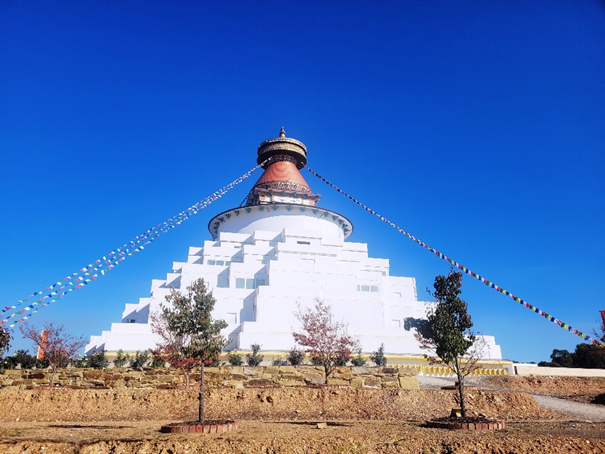
The place felt like a quiet symbol of the trip itself: different cultures, beliefs, and traditions coexisting in mutual respect.
What This Journey Left Me With
This journey reminded me that travel, at its best, is not consumption—it is relationship.
Through SERVAS, I was invited into homes, gardens, schools, forests, kitchens, and conversations. I encountered not only landscapes, but values: ecological stewardship, intergenerational living, mindfulness, simplicity, creativity, activism, and hospitality.
Across six weeks, strangers became friends. Brief encounters became meaningful exchanges.
In a world that can often feel increasingly fragmented, hurried, and transactional, this journey reaffirmed something I deeply needed to remember:
There are no strangers—only friends waiting to be discovered.
I return home grateful—to each of my hosts, to SERVAS, and to the many quiet moments of reciprocity and connection that made this journey unforgettable.
More about Servas: https://servas.org/
Also read: Travel As Transformation
Written by –
-Vipul Shaha, India
Psychotherapist, Educator,
Mindfulness and Nature-based Facilitator
Pune, India
@mindful_being_india


Comments